EXW
Ex Works
Seller makes goods available at their premises. Buyer handles nearly everything after pickup.
Best for domestic-style pickupsLearn who pays, who carries the risk, and how to choose the right Incoterm for every international shipment.
Whether you're exporting for the first time or shipping hundreds of containers every month, choosing the wrong Incoterm can create unexpected transportation costs, customs delays, insurance disputes, and unhappy customers.
This guide explains every Incoterm in plain English, shows exactly when risk transfers from seller to buyer, and helps you avoid the most common mistakes exporters make.
Incoterms are internationally recognized trade rules published by the International Chamber of Commerce. They help buyers and sellers define who is responsible for transportation, export handling, import handling, insurance, and risk at each point in an international shipment.
They do not replace a sales contract, purchase order, payment agreement, or logistics plan. Instead, they create a shared language so everyone understands where the seller's responsibility ends and the buyer's responsibility begins.
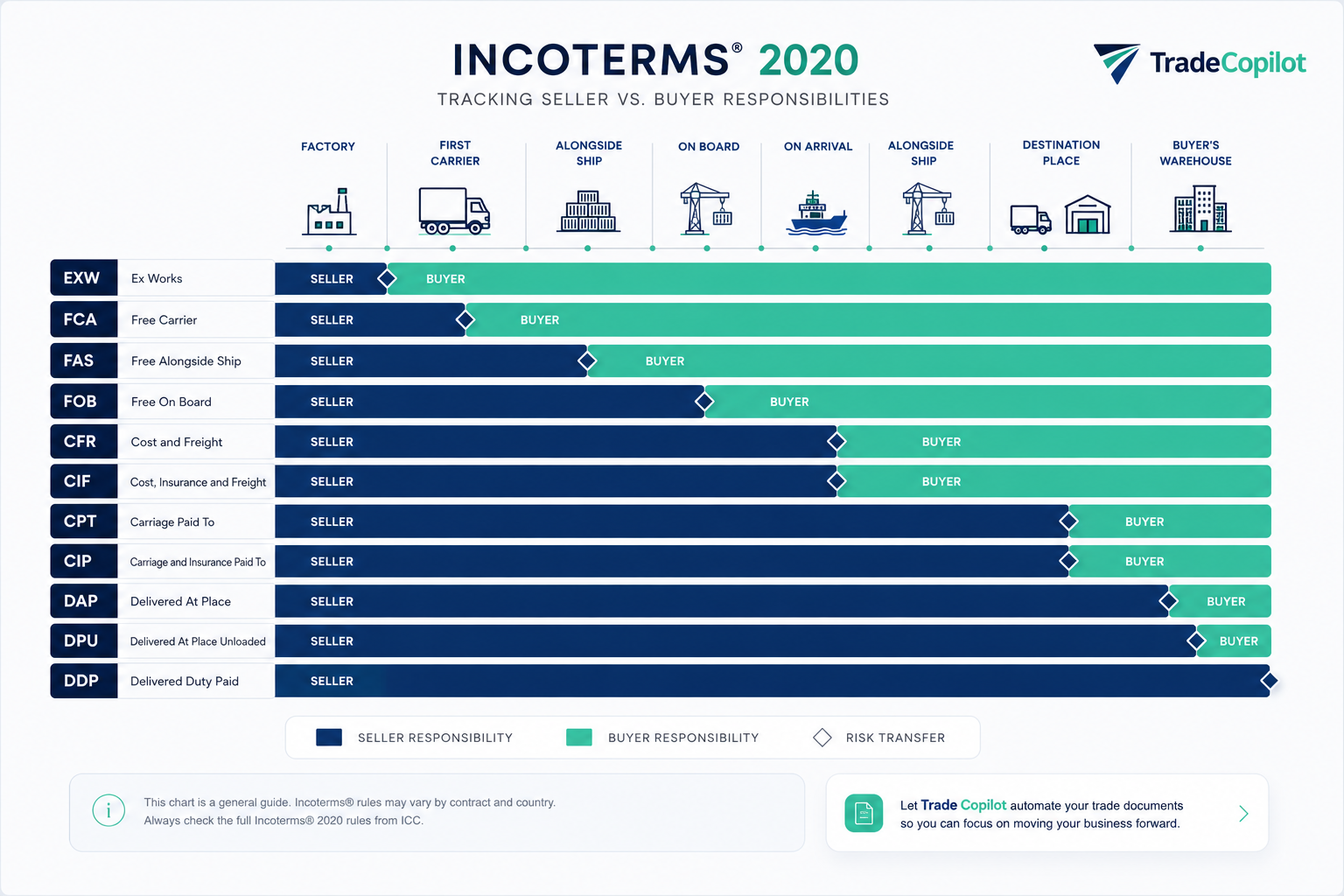
Incoterms responsibility timeline showing where costs and risks transfer between seller and buyer.
Each Incoterm defines a different operating model for cost, control, and delivery responsibility.
Seller makes goods available at their premises. Buyer handles nearly everything after pickup.
Best for domestic-style pickupsSeller delivers goods to a named carrier or place after export clearance.
Best for container shipmentsSeller delivers goods alongside the vessel at the named port of shipment.
Best for bulk ocean cargoSeller delivers goods loaded on board the vessel. Risk transfers once goods are on board.
Best for non-container ocean freightSeller pays ocean freight to destination port, but risk transfers when goods load on vessel.
Best for ocean freight without insuranceSeller pays freight and minimum insurance to destination port, while risk transfers earlier.
Best for ocean shipments needing seller insuranceSeller pays carriage to a named destination, but risk transfers to buyer at carrier handoff.
Best for multimodal transportSeller pays carriage and higher insurance coverage to the named destination.
Best for air and multimodal insured shipmentsSeller delivers goods ready for unloading at the named destination. Buyer handles import clearance.
Best for seller-controlled deliverySeller delivers and unloads goods at the named destination place.
Best when seller controls unloadingSeller carries the most responsibility, including import clearance and duties at destination.
Best for fully managed deliveryContainer cargo is usually handed to a carrier before vessel loading, which often makes FCA a better fit.
An Incoterm without a place leaves teams guessing where cost and risk transfer.
Only CIF and CIP require the seller to provide insurance, and coverage levels differ.
Always name the rule version so buyers, sellers, forwarders, and banks apply the same standard.
Incoterms do not decide title transfer, payment timing, credit terms, or ownership.
FOB Shanghai Incoterms® 2020
DAP Dallas Texas Incoterms® 2020
CIP Hamburg Airport Incoterms® 2020
FOB
DAP
CIF
Trade Copilot helps export teams turn shipment data into complete, reviewable, and deliverable trade workflows. Instead of managing documents, approvals, customer updates, and shipment records across disconnected tools, your team can operate from one AI-powered workspace.
The platform automates Commercial Invoice, Packing List, Certificate of Origin, Bill of Lading, Shipment Tracking, Approvals, Customer Communication, HTS Codes, and AI Assistant workflows.
An Incoterm is an international trade rule that defines responsibilities between seller and buyer for delivery, costs, and risk transfer.
Common choices include FCA, FOB, CIF, DAP, and DDP, but the right rule depends on transport mode, control, insurance, and destination responsibilities.
No. Incoterms do not define title transfer, ownership, payment timing, or credit terms. Those belong in the sales contract.
It depends on the Incoterm. For example, CFR, CIF, CPT, and CIP require the seller to pay main carriage, while EXW and FCA shift more freight responsibility to the buyer.
Use the rule that matches your delivery control, transport mode, risk tolerance, insurance needs, and customer agreement. For container exports, FCA is often more precise than FOB.
Use Trade Copilot to automate trade documents, approvals, shipment tracking, and customer communication from one AI-powered workspace.